
Searching Williamson County Civil Dockets
The Williamson TnCIS search gives you three civil office routes. Pick Circuit Court for major civil suits, divorce, name changes, condemnation, and lower-court appeals. Pick General Sessions Civil for small claims under $25,000, detainer warrants, subpoenas, and writs. Pick Clerk and Master for Chancery, probate, trust, conservatorship, real-estate, domestic, and delinquent-tax matters. Then select Civil and run your docket search.
A full party name usually gives the cleanest match. Case Year and Case Number narrow results further, but be aware the criteria compound. Per the official help, a formatted identifier like 99GS1-2023-CV-12345 adds only 12345 to the Case Number field. A legacy case reference belongs in Party Name instead. Is the full image not online? Then call the Circuit Court Clerk or Clerk & Master. You can also visit the counter, or send a focused written copy request.
- Identify Circuit, General Sessions Civil, or Clerk and Master.
- Select Civil and enter the full party name or case reference.
- Add the filing year or numeric case suffix if needed.
- Complete Turnstile and use Find Now.
- Sort or filter results, then ask the responsible clerk for copies.
Williamson Civil Files Went Paperless
Williamson Circuit Civil files have been paperless since July 1, 2022. Filers are directed to Tybera eFlex, which works with TNCIS. Note the split in jobs here. eFlex receives filings from lawyers and parties. The public TnCIS interface is what a reader uses for case lookup.
Local General Sessions Civil rules treat an e-filed document as the official filing. Complete it before midnight local time. It then counts as filed that day. The transaction receipt proves submission. A rejected document never enters the official record. Filers must keep signed or notarized originals through final disposition and any appeal.
Keep the receipt: A Tybera transaction receipt proves submission, but acceptance into the official record still depends on the clerk's review.
Inside a Williamson County Civil Docket
Think of a civil docket as a chronological register rather than the whole document set. It lists parties, filings, motions, settings, orders, and final disposition. It also identifies the court office and case number. Calendar sheets can add the judge, courtroom, time, matter, clerk, and court officer. A label like “Civil Motions” or “Pretrial Conference” marks a setting. It is not a result.
| Case number | The court's identifier and filing-year context. |
|---|---|
| Parties | Plaintiff, petitioner, defendant, respondent, or other role shown publicly. |
| Filings | Complaint, petition, answer, notice, exhibit, or other indexed paper. |
| Motions and settings | Requested relief and the dates set for court action. |
| Orders and disposition | Recorded rulings, dismissal, settlement category, transfer, or judgment. |
A docket entry can prove an item was filed even when the image is missing. When the public screen skips it, ask for the document by exact title and date.
Williamson Civil Search Fields
The public form uses Party Name, Match all search terms, Case Year, and Case Number. Court-office and Civil filters set which database you search. Check Turnstile first. Otherwise Find Now will not activate. Sort results by column or narrow them with the real-time Filter box. The portal caps results at 2,500, so pair a common name with the most reliable year or office.
| Control | Best use | Search caution |
|---|---|---|
| Party Name | Full first and last name | Also accepts case reference |
| Case Year | Original filing year | Wrong year excludes a match |
| Case Number | Numeric final segment | Do not paste the whole formatted value |
| Court office | Match case subject to custodian | At least one office is required |
The official blank civil search displays those choices without revealing private case data.
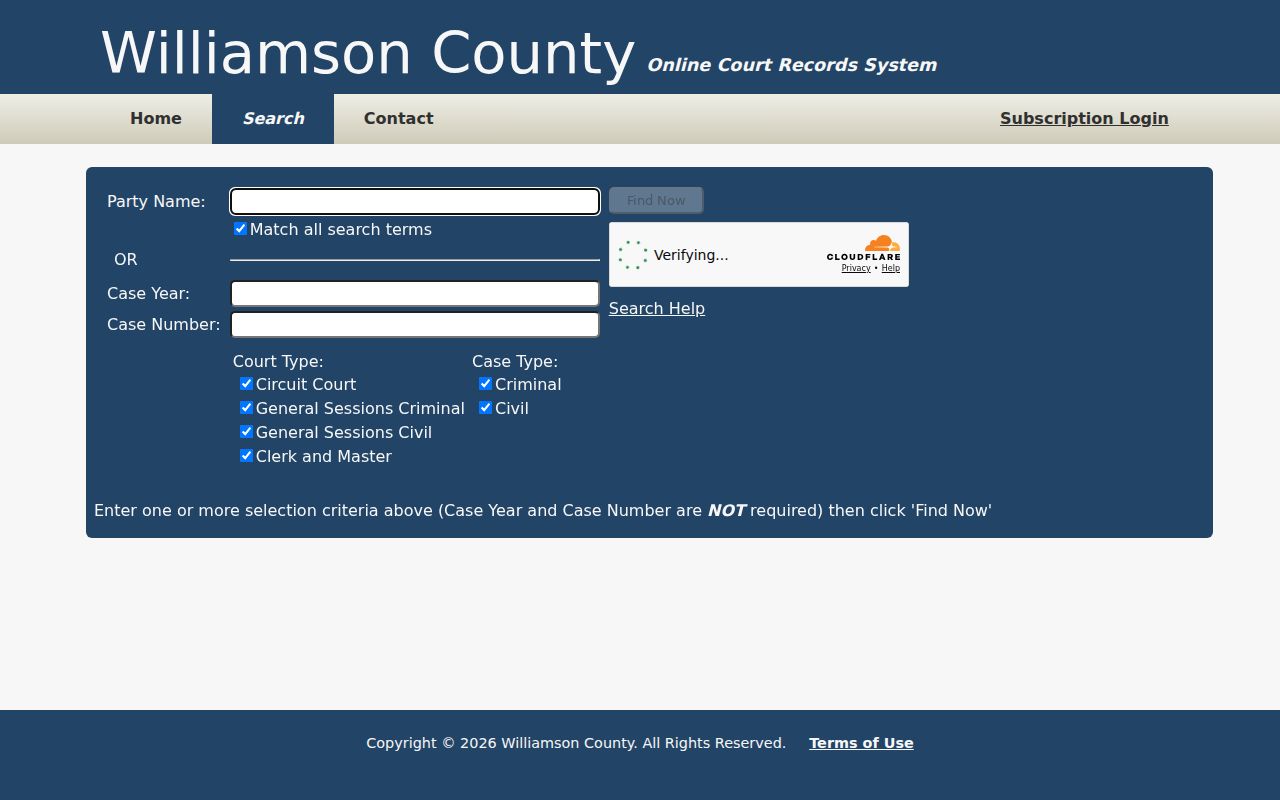
The interface makes the office split plain. That routing choice drives any Williamson County civil docket search.
Civil Case Types on the Docket
Williamson County civil matters run through three distinct trial channels. Circuit and Chancery do not simply split cases by dollar value. Subject matter, statutory authority, and the court named on the papers decide the route. General Sessions Civil stays the lower civil forum. It handles its defined claims and processes.
- Circuit lawsuits over $25,000, tort claims, contracts, divorce, name changes, and appeals.
- General Sessions small claims under $25,000, detainers, writs, and subpoenas.
- Chancery probate, trusts, estates, conservatorships, real property, and delinquent taxes.
- Domestic and parenting matters assigned within the Circuit or Chancery structure.
- Administrative and lower-court appeals within Circuit jurisdiction.
The official Williamson forms index shows the range: civil summonses, cost bonds, detainer warrants, writs of possession, garnishment forms, name-change petitions, divorce papers, and appeal notices. A form category can hint at the right route. It is not legal advice on what to file.
Williamson Chancery Probate Route
For probate, parenting and divorce material, delinquent taxes, local rules, fees, forms, and the motion calendar, turn to the Williamson Chancery site. Jakob Schwendimann serves as Clerk & Master. So a probate or trust docket search should use Clerk and Master in TnCIS, not General Sessions Civil.

The site navigation shows why “civil” is not one file room. Chancery keeps its own motion-calendar and subject-matter paths. The county search can still display its court records beside other civil offices.
Fiscal year 2024-25 AOC data reported 575 probate or trust filings out of 2,125 Williamson Chancery filings. That was the largest listed Chancery category. These are reported filing counts. They are not a live docket total, and not a promise that every probate document is public online.
Civil Docket Settings and Hearings
Williamson weekly assignment sheets carry plenty of labels. Examples include Civil Motions, Pretrial Conference, domestic motions, jury-trial day counts, and special-set bench trials. Read each label as the planned type of court activity. Pair the entry with its date, judge, courtroom, and time. Then check the case docket for later changes.
A motion setting is not a judgment. A pretrial conference is not the trial itself. A multi-day trial label may reflect just the planned day within a longer setting. A continuance can move the hearing while leaving the filed motion in place. Does a date truly matter? Pull the latest docket and confirm with the clerk. Do not trust an older PDF.
Note: Scheduling orders and docket entries can change. The responsible Williamson County clerk is the source for the current setting.
Williamson Civil Division Assignment
Civil cases filed in Circuit Court get a random division at the start. There are four of them: Divisions I through IV. A case usually stays put until it ends. The Circuit Court Judges page lays out the official structure. Knowing the division ties a Williamson County court docket to one judge. It also connects that docket to the courtroom's hearing calendar.
Check assignments against the official judges list before relying on old papers. A case file may name a judge whose division has since changed. The current source wins. Assignment is also random within Circuit only. It never mixes a case into Chancery or General Sessions. The office filter comes first in any docket search. After that, the case number, division, and caption give a clerk everything needed to pull the court record.
Williamson Civil Filing Snapshot
The AOC counted 2,125 Chancery filings in Williamson County for fiscal year 2024-25, against 781 Circuit civil filings. Chancery handled probate or trust, divorce, residential parenting or child support, contract or debt, and conservatorship or guardianship. Over on the civil Circuit docket, the mix ran to damages or torts, miscellaneous civil matters, contract or debt, divorce, and administrative appeals.
A separate snapshot is dated September 30, 2024. It put pending civil matters at 118 in Chancery and 45 in Circuit. Most sat in the zero-to-three-year band. Read that count as a one-day tally, not a live backlog figure. Totals of filings and closures can also double-count, so they may not match unique cases.
Civil Docket Access Rules
Tennessee Supreme Court Rule 34 opens public court records to the public while honoring statutory exceptions and limits a court has ordered. Sealed files, protective orders, confidential material, judicial work product, drafts, internal management records, and anything whose release would disrupt court operations can stay closed. Chancery and juvenile-related content faces extra limits in places.
Request precisely: Give the Williamson court office, case year or number, document title, date range, and whether inspection, a plain copy, certification, or an appeal record is needed.
Under Tennessee Code Annotated section 10-7-503, the Williamson County policy splits inspection from copies. You can ask to inspect a court record orally or in writing. Copies are different. They take the written county form. The clerk still decides who touches the file. General county page rates cover plain pages. They do not cover court copy, certification, filing, process, or appeal-record fees. In General Sessions Civil, a public access terminal sits in the clerk's office. It stays open during normal business hours. Older research has another route entirely. Williamson County Archives indexes Chancery records from 1815 through 2018. Circuit civil records run from 1805 through 2004. For genealogy, property, or old case lookup, TnCIS is hardly the only channel.